
Living in Phuket: Thailand’s visa options for 2026

Phuket long-term residents can choose between Thailand Privilege, the LTR Visa, retirement extensions, the DTV, Non-Immigrant B or family-based routes, each with distinct costs, validity and work rights. Buying property does not itself confer any visa or residency status, though it may support certain applications. Visas, tax residency and citizenship remain separate legal concepts requiring individual professional advice.
- Property purchase in Phuket never automatically grants a visa or residency status.
- Thailand Privilege offers paid long-term stay but no work rights or permanent residency.
- LTR Visa eligibility is criteria-based, covering wealthy, retired, remote-working or skilled applicants.
- Retirement extensions require ongoing financial proof and annual renewal, with no employment allowed.
- Spending 180+ days in Thailand may trigger tax residency regardless of visa type held.
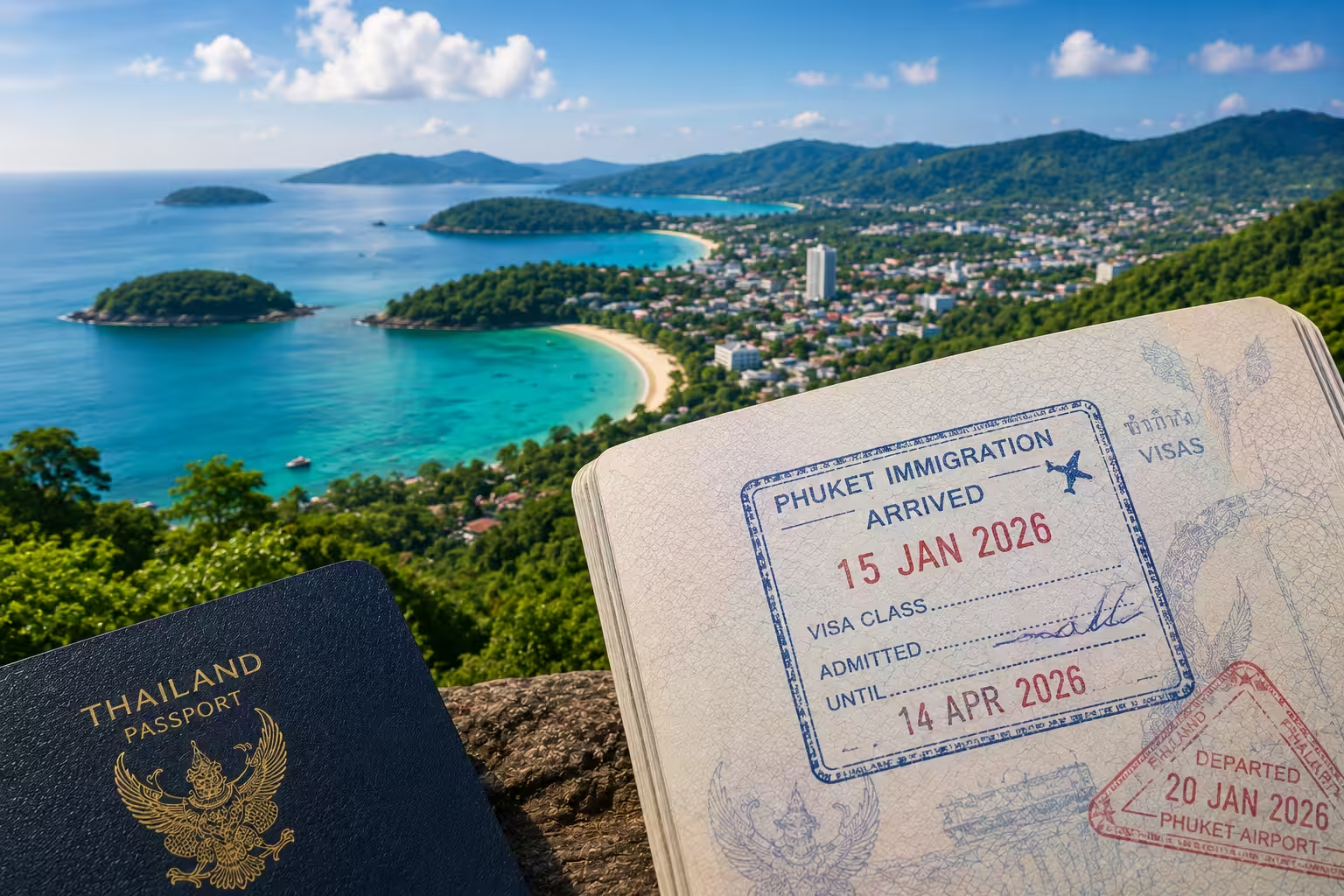
Moving to Phuket long term means choosing from several distinct visa routes, each with its own cost, validity and rules on work. Thailand Privilege, the LTR Visa, retirement extensions, the Destination Thailand Visa and Non-Immigrant B all serve different residents, and none of them is automatically unlocked by buying a villa or condominium.
This guide sets out how each option works in 2026, who it suits, and where property ownership genuinely matters.
Thailand Privilege: a paid route to long-term residency
Thailand Privilege, formerly marketed as Thailand Elite, is a paid membership programme administered by a state enterprise rather than a conventional visa category. Membership is generally open to applicants regardless of age, employment status or property ownership, which makes it a popular option among those who do not qualify for retirement, work or investment-linked visas.
Membership tiers vary by validity period and price, with longer terms and higher fees typically bundled with additional services. As of August 2026, prospective members should confirm current tiers, fees and inclusions directly with Thailand Privilege, as packages are periodically revised.
Core benefits usually include multi-year permission to remain in Thailand with minimal reporting, airport fast-track and lounge access, and concierge support with visa extensions and immigration paperwork. Membership grants long-term permission to stay in the Kingdom; it does not confer permanent residency, citizenship, or automatic work rights.
The LTR Visa: categories for high-net-worth and skilled residents
The Long-Term Resident (LTR) Visa is administered by Thailand’s Board of Investment and designed to attract foreign residents considered valuable to the economy. Unlike Thailand Privilege, eligibility is criteria-based rather than a straightforward purchase.
Four principal categories exist: wealthy global citizens, assessed on personal assets and income; wealthy pensioners aged 50 and over, assessed on pension or passive income; work-from-Thailand professionals, employed remotely by an established overseas company; and highly skilled professionals, employed or engaged in Thailand within specified sectors. Each category carries its own thresholds for income, assets, employment contract or professional experience, which applicants should confirm directly with the BOI as of August 2026.
The LTR Visa is typically granted for an extended, renewable period rather than a single year. Certain categories, notably work-from-Thailand professionals and highly skilled professionals, come with digital work permit provisions, distinguishing this route from purely residence-based options.
Retirement visas for those aged 50 and over
For retirees, the long-established route is the Non-Immigrant O-A visa, or its longer-validity counterpart the O-A, obtained from a Thai embassy or consulate, followed by annual extensions of stay arranged through Thai immigration once resident in Phuket. Some applicants instead enter on a standard Non-Immigrant O visa and convert to a retirement extension locally. Requirements vary by immigration office, so applicants should confirm the current position directly.
The general financial test involves holding a minimum sum in a Thai bank account, evidencing a minimum monthly income, or a combination of both, with funds typically needing to be seasoned for a period before application. Figures and seasoning periods should be verified with immigration as of August 2026 rather than assumed from older sources.
This route does not permit employment in Thailand. Extensions are renewed annually, subject to continued financial evidence and periodic reporting.
The Destination Thailand Visa and Non-Immigrant B: working, business and remote life
The Destination Thailand Visa (DTV) is aimed at remote workers, freelancers and long-stay visitors who earn from outside Thailand and have no need for local employment. It suits digital nomads, consultants and families wanting extended time in Phuket without a traditional Thai job. The DTV is typically issued for multiple entries over a five-year validity, with each stay permitted for a set period before requiring either departure or an extension application at Thai immigration.
Those genuinely employed by a Thai-registered company, or operating their own licensed Thai business, generally require a Non-Immigrant B visa rather than the DTV. Non-Immigrant B status is the immigration side of the equation only; it must be paired with a separate work permit before any work legally begins. Requirements for both documents, and the company conditions behind them, should be confirmed with a qualified immigration or corporate adviser.
Marriage and family-based visa options
Foreigners married to a Thai national typically apply under the Non-Immigrant O category, which also covers dependents of certain other visa holders, such as children of a work permit holder. This route allows extended stays in Phuket tied to the family relationship rather than employment or investment.
Marriage-based extensions generally carry a financial requirement, met either through a Thai bank account holding a specified balance for a set period or through demonstrable income, sometimes in combination. Exact figures and evidentiary standards are set by Thai immigration and can be applied with some variation between offices.
Because documentation, timing and local immigration practice all matter here, anyone considering this route should confirm current requirements with a qualified immigration professional rather than relying on general guidance.
Comparing the main options: a quick-reference table
The summary below brings together the routes covered so far, purely as a starting point for discussion. It is not exhaustive, and individual eligibility depends on nationality, personal circumstances and the immigration office handling the application.
- Thailand Privilege: best suited to those wanting turnkey, hassle-free long-stay membership without work rights; validity of 5-20 years depending on tier; cost is a one-off membership fee; no work rights; eligibility is largely financial (membership fee) rather than sponsorship-based.
- LTR Visa: best suited to high-net-worth individuals, wealthy pensioners, remote professionals and skilled workers; 10-year validity; government fee plus category-specific financial thresholds; work rights permitted for eligible categories; eligibility varies significantly by category.
- Retirement visa/extension: best suited to those aged 50 and over settling in Phuket; typically renewed annually; modest application fees plus ongoing financial requirements; no work rights; requires maintained funds and reporting.
- DTV: best suited to remote workers, freelancers and long-stay visitors; multi-entry validity with extended permitted stays per entry; moderate government fee; no local employment rights; income or activity must be foreign-sourced.
- Non-Immigrant B: best suited to those genuinely employed or operating a business in Thailand; typically annual validity; fees tied to visa and work permit process; work rights only with a valid work permit; requires a qualifying employer or registered business.
- Marriage/family-based (Non-Immigrant O): best suited to spouses and dependents of Thai nationals or certain visa holders; typically annual renewal; modest fees; work rights require separate permit; eligibility tied to the family relationship and financial requirements.
Does buying property in Phuket give you a Thai visa?
No. Purchasing a condominium, a villa, or a leasehold or company-holding structure over land does not itself confer any immigration status. Thailand’s property and immigration systems are entirely separate, and there is no route by which a purchase contract alone generates a visa, a long-term permission to stay, or a path to permanent residency or citizenship.
Property ownership can, however, support certain applications indirectly. It may help demonstrate financial substance or genuine ties to Thailand as part of a wider application, and in some LTR Visa categories, qualifying investment (which can include Thai property) forms part of the asset or investment criteria under specific conditions set by the relevant authority.
This leads to a common misconception worth correcting directly: a high-value purchase, however substantial, does not automatically qualify a buyer for the LTR Visa or any other residency status. Each visa category has its own eligibility criteria, and property forms at most one element of a broader financial or professional picture.
Visas, tax residency and citizenship: what long-term residents need to understand
A visa, long-term permission to stay, tax residency, permanent residency and citizenship are five distinct legal concepts, governed by different authorities and rarely aligned automatically. Holding a long-term visa does not, by itself, determine Thai tax residency.
As a general and widely cited principle, spending 180 days or more in Thailand within a calendar year may bring an individual within scope of Thai tax residency rules, though application depends on personal circumstances and is a matter for a qualified tax adviser, not immigration status alone.
Illustrative scenarios: a retiree on a retirement extension, a DTV-holder renting a condo remotely, a Non-Immigrant B business owner, an LTR-qualifying executive, and someone splitting time between Phuket and abroad may each face entirely different tax and residency positions.
This article is general information, not legal, immigration or tax advice, and requirements change. Contact Anan Property Group to be introduced to appropriately qualified professionals while exploring property in Phuket.

Ayara Villa | Sea View Luxury Villa in Surin, Phuket


Baan Banyan | Iconic Sea View Estate on Kamala Headland, Phuket

Luxury Pool Villas in Pasak Soi 8, Cherng Talay (Bang Tao), Phuket

Luxury Pool Villas in Pasak Soi 8, Cherng Talay (Bang Tao), Phuket

Final Two Luxury Pool Villas in Bang Tao | Ready to Move In
Ultra-Luxury 4-Bedroom Estate with Cinema & Gym near Layan Beach,...
Related reading


